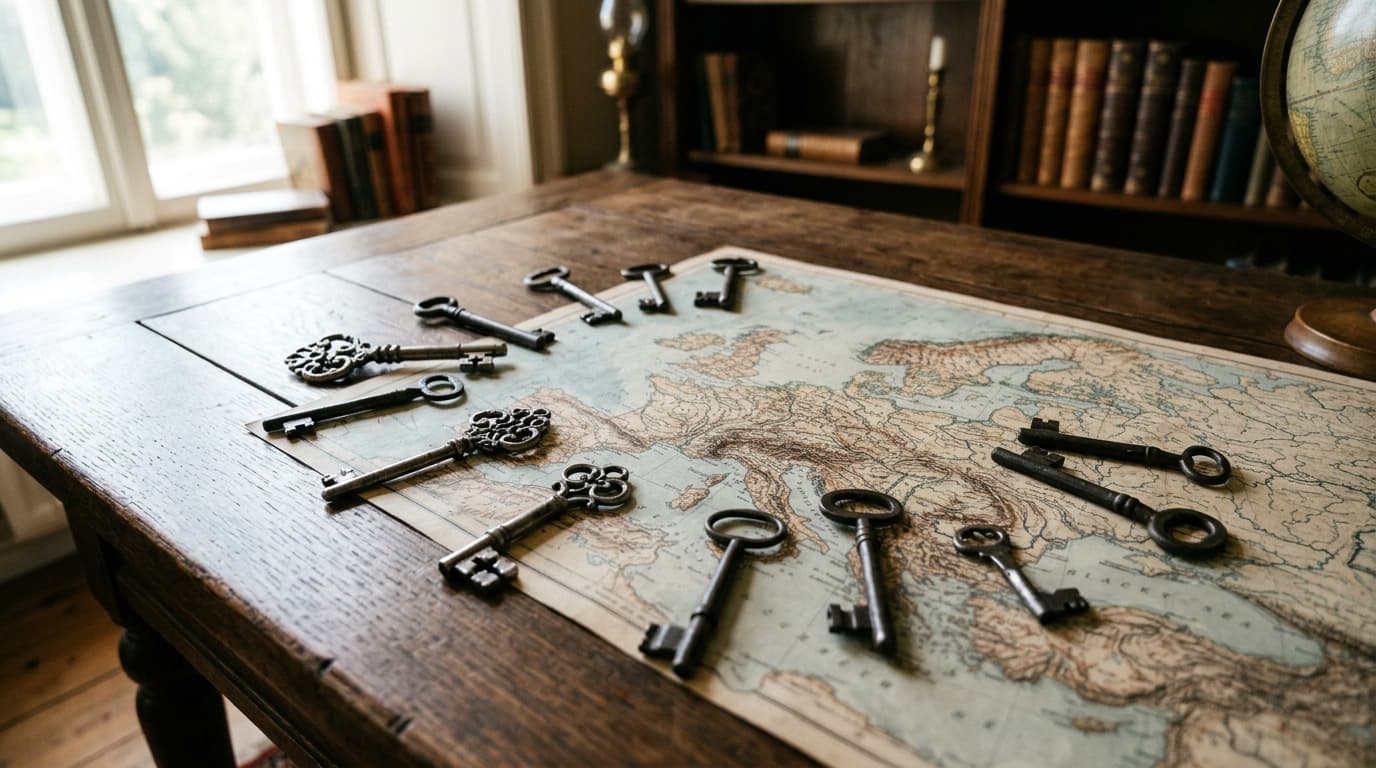

Owning a home in Europe is a dream for many. Imagine morning coffees in a Parisian cafe, sunny afternoons on a Portuguese terrace, or cozy evenings in a German cottage. This dream is more achievable than ever for foreigners. Technology has made it easier to find properties across the continent. However, the excitement of the search can quickly turn to anxiety. The reality of buying property in Europe is complex. You face a patchwork of different laws, languages, and tax systems.
You might feel overwhelmed. It seems you need to learn 27 different ways to buy a house. This is a common feeling for non-resident buyers. But there is a simpler way to think about it. You do not need to be an expert on every country's rules. Instead, you need a clear framework that works anywhere in Europe. This guide provides that framework. We will break down the entire process into three simple phases: Search, Legal, and Financial.
In this guide, we will show you the universal steps that apply to every purchase. We will also highlight the local differences you must watch for. We will debunk common and costly myths about European property. By the end, you will have a clear map to follow. This will help you navigate your purchase with confidence and avoid expensive surprises.
The Universal Truth: Why European Property Transactions Are So Complex
The main reason for the complexity is simple. There is no single 'European property law'. The European Union sets many rules, but property law is not one of them. Each of the 27 member states decides its own rules for buying and selling real estate. This means you are not dealing with one system. You are dealing with 27 separate legal systems, tax codes, and consumer protection standards. A recent study from Maastricht University confirmed that the high complexity of cross-border property deals is a major barrier for buyers. It creates confusion and risk for those unfamiliar with the local landscape.

Think of it like traveling with your electronic devices. This is a useful analogy. When you travel, you need a power adapter to plug in your phone or laptop. The plug you need for the UK is different from the one for Italy. And the one for France is different again. You cannot use the same plug in every country. Each country's 'socket' is unique. Buying property in Europe is the same. Each country requires a different 'legal adapter' to complete the purchase. This adapter is made of that country's specific laws, taxes, and professional roles.
This leads to key differences in professional roles. In many European countries, a public Notary plays a central role. However, their function is often misunderstood by buyers from countries like the US or UK.
The Notary is a neutral state official. They ensure the transaction is legal and that taxes are paid. They are not your personal lawyer.
They do not represent your interests. This is a crucial distinction. You also have language barriers.
Contracts, legal documents, and official communications will be in the local language. Without expert help, this adds another layer of risk. Your job as a buyer is not to become a legal expert.
Your job is to understand this core complexity. Then you can build a team of local experts to provide the correct 'adapter' for your purchase.
The lack of a unified system means that due diligence is paramount. What constitutes a thorough check in one country might be insufficient in another. For example, some nations have a single, highly reliable Land Registry that guarantees title. Others may have separate systems for legal ownership (Land Registry) and physical boundaries (Cadastre), both of which must be checked. These differences highlight why a one-size-fits-all approach is doomed to fail. Understanding that these variations are the norm is the first step toward a successful transaction. The framework in this guide will help you ask the right questions at the right time, no matter where in Europe you decide to buy.
Phase 1: The Search & Discovery Phase (The Modern Way)
The journey to owning a European home begins with the search. For decades, this process was difficult and inefficient for foreign buyers. It involved relying on local agents with limited listings or flying to different countries for viewings. Technology has dramatically changed this phase. The modern search process is faster, more efficient, and gives you more power than ever before. It allows you to explore vast markets from the comfort of your home. However, it is important to understand how to use these new tools effectively. The goal is to cut through the noise and find properties that truly match your needs, not just what a simple filter shows you.
This phase is about more than just looking at pictures of houses. It is about defining your goals and using technology to find hyper-relevant options. Are you looking for a holiday home, a retirement spot, or an investment? Your answer will shape your search. The tools available in 2026 can help you explore options across different countries and regions simultaneously. This was impossible just a few years ago. Let's explore how the search process has evolved and how you can take advantage of the latest technology.

Beyond Traditional Portals (Historical Context)
Traditional property portals were a major step forward. Websites like Rightmove in the UK or Idealista in Spain brought thousands of listings online. They replaced the need to visit dozens of individual real estate agent offices. These platforms were revolutionary for their time. They allowed buyers to filter properties by basic criteria. You could select a country, then a city, and then filter by the number of bedrooms and price. This was a huge improvement.
However, this model has significant limitations, especially for cross-border buyers. The rigid filter boxes force you into a narrow search. What if the perfect home is in a town you have never heard of? What if you are open to either Spain or Portugal but do not want to run two separate searches? The filter-based approach creates a lot of 'noise'. It surfaces countless irrelevant listings that happen to match the filters but not your actual desires. You are forced to scroll through pages of unsuitable properties. This process is time-consuming and often frustrating.
The 2026 Advantage: Conversational AI Search
The biggest change in property search for 2026 is the rise of conversational AI. This technology moves beyond rigid filters. It allows you to search using normal, everyday language. You can describe your ideal home just as you would to a friend or a top real estate agent. This is a game-changer for finding relevant properties across borders. It understands your intent, not just keywords.
Instead of clicking boxes, you can simply type what you want. For example, you could search for: "Find me a three-bedroom home with a garden and good natural light, within a 30-minute commute of a major tech hub in Spain or Portugal." An AI-powered conversational search can understand this complex request. It will scan markets in both countries and return only the most relevant options.
This saves you dozens of hours of manual searching. It can also suggest locations that meet your criteria but that you might not have considered. This is a more intuitive and powerful way to explore the market. Using a platform like one-place.com helps buyers cut through the noise of traditional real estate portals.
Virtual Due Diligence
Another major shift is the quality and availability of virtual viewing tools. In the past, a 'virtual tour' might have been a simple slideshow of photos. Today, high-quality 360-degree virtual tours are becoming standard. These tours allow you to walk through a property digitally. You can look up at the ceilings, down at the floors, and out of the windows. This gives you a much better sense of the space and layout than photos alone.
For cross-border buyers, this is incredibly valuable. It helps you create a credible shortlist of properties without needing to travel for initial viewings. You can rule out properties that look good in photos but have a poor layout or low ceilings. This saves you time and money. While a virtual tour will never fully replace an in-person visit before you buy, it makes the initial search phase much more efficient. It allows you to focus your travel time on visiting only the most promising properties.
Phase 2: The Legal & Due Diligence Phase (Your Protection Team)
Once you find a property you love, you move into the most critical phase of the transaction. This is the legal and due diligence phase. It is where you protect your investment and ensure you are buying a property free from problems. Many first-time foreign buyers make their biggest mistakes here. They might rush the process or rely on the wrong people for advice. The key to success in this phase is to build your 'protection team'. This team is led by one person: your independent lawyer.

This phase is not the place to cut costs. The fees you pay for good legal advice are an investment, not an expense. A good lawyer will save you from potential disasters that could cost you many times their fee. The process is sequential and logical. Each step builds on the last, ensuring that you are fully protected before you part with your money. It is vital to follow these steps in order and not to skip any, no matter how tempting it may be. Here is the sequence you should follow in any European country.
- Assemble Your Team (Do This First!): Before you even make an offer, you must hire an independent, bilingual lawyer. They should specialize in property transactions for foreigners in that specific country. Do not use the lawyer recommended by the seller or the real estate agent. Their loyalty may not be to you. Your lawyer is your advocate. They work only for you. This is the single most important decision you will make in the entire process.
- The Offer & Preliminary Agreement: Once your lawyer is in place, you can make a formal offer. Your lawyer will help you draft this to ensure it includes protective clauses. If the seller accepts, you will typically sign a preliminary contract. This document has different names in different countries (e.g., *Contrato Promessa de Compra e Venda* in Portugal, *Compromis de Vente* in France). This contract locks in the price and terms. It usually requires you to pay a significant deposit, often 10% of the purchase price. Your lawyer must review this contract before you sign.
- Lawyer's Due Diligence: This is where your lawyer earns their fee. After the preliminary contract is signed, they will perform comprehensive checks. They will verify that the seller is the true owner by checking the Land Registry. They will check for any debts, mortgages, or liens against the property. They will check the Cadastre (the official property map) to ensure the physical boundaries match the legal documents. They will also check for building permits and ensure the property was built legally. This process uncovers any hidden problems.
- The Notary & The Deed of Sale (Escritura): Once your lawyer confirms the due diligence is clear, you will proceed to the final signing. This happens in front of a public Notary. The Notary's role is to witness the signing of the final deed of sale (often called the *Escritura*). They verify the identities of the buyer and seller. They confirm that the money has been transferred and that taxes will be paid. Crucially, the Notary is a neutral public official. They do not work for you. They ensure the transaction is legal for the state, not that it is a good deal for you. This is a common and dangerous myth. Your lawyer protects you; the Notary protects the legality of the public record.
- Registration: The final step is to make your ownership official. After the deed is signed, your lawyer or the Notary will take the deed to the official Land Registry. They will register the property in your name. Only when this registration is complete are you the undisputed legal owner of the property. You will receive a copy of the updated title deed as proof of ownership.
Following this sequence diligently is your best insurance against future problems. It ensures that every aspect of the property's legal status is verified by a professional who is working solely in your interest. The peace of mind this provides is invaluable, especially when investing in a foreign country.
Phase 3: The Financial & Tax Phase (Avoiding Expensive Surprises)
The price you agree to pay for your property is just the beginning. One of the biggest shocks for foreign buyers is the amount of additional costs. These taxes and fees can add a significant amount to your total bill. A good rule of thumb is to budget for an extra 10% to 15% of the purchase price. This will cover all the necessary taxes, professional fees, and other transaction costs. Ignoring these costs can put your entire purchase at risk. It is vital to understand them from the start so you can budget accurately.

This financial phase is not just about paying bills. It is also about being smart with your money. A key area where buyers lose thousands is in currency exchange. Transferring a large sum of money from your home currency to Euros can be expensive if not done correctly. We will break down the typical costs you can expect. Understanding these details will help you avoid costly surprises and manage your budget effectively. The table below provides a clear overview of the main costs you will face. Remember that the exact percentages will vary by country and even by region within a country.
| Cost Category | What It Is | Typical Range (% of Property Value) | Local Variable Example |
|---|---|---|---|
| Property Transfer Tax (PTT) | Tax on the purchase of a resale property. | 3% - 10% | Varies dramatically. Spain's rate differs by region (e.g., 10% in Valencia vs. 7% in Madrid). |
| VAT (Value Added Tax) | Tax on the purchase of a brand new property from a developer. | 10% - 21% | In Spain, VAT on new homes is 10%; in Portugal, it's 23% (though often included in the price). |
| Notary & Registry Fees | Mandatory fees for the Notary's service and registering the deed. | 0.5% - 2% | Often set on a sliding scale based on the property price. German notary fees are a percentage of the sale price. |
| Legal Fees | Fee for your independent lawyer's due diligence and advisory work. | 1% - 1.5% | A non-negotiable cost to protect your investment. |
| Currency Exchange Cost | The cost of converting your home currency to Euros. | 0.5% - 4% | Using your bank can cost 3-4%; a specialist broker can reduce this to under 1%. |
| Annual Property Tax (IBI, etc.) | Ongoing tax paid yearly to the local municipality. | 0.2% - 1.5% | A recurring cost to budget for. |
| Non-Resident Imputed Income Tax | A tax on the "benefit" of owning a property, even if not rented out. | Varies | Spain, for example, charges this tax via the Modelo 210 form. |
Beyond these listed costs, it is also important to address a common myth. Many people used to believe that buying property was a shortcut to gaining EU residency. As of 2026, this is largely untrue. Major 'Golden Visa' programs in countries like Spain and Portugal, which tied residency to property investment, have been closed. You must now seek residency through other paths, such as digital nomad visas or non-lucrative visas. Property ownership is now separate from your residency application. This makes it even more important to buy a property because you love it, not as a means to an administrative end.
What This Means For You in 2026
Buying a property in Europe is a significant but rewarding undertaking. The market in 2026 is more accessible than ever, but it is also more complex. The old link between property purchase and residency is gone. This requires a shift in mindset. Success now depends on a smart, two-part strategy. You must combine the best of technology with the best of human expertise.

First, use modern, AI-driven tools for the search phase. This will help you scan the entire European market efficiently. It will allow you to find hidden gems and hyper-relevant properties that match your specific lifestyle needs, not just basic filters. This saves time and broadens your horizons. Second, you must build a trusted team of human experts for the transaction phase. The most important member of this team is your independent lawyer. Their job is to protect you, perform due diligence, and guide you through the local legal system. A good currency specialist is also vital to save you money.
The process is complex, but it is not impossible. By understanding the three phases—Search, Legal, and Financial—you have a universal map. This map can guide you through any European market. It empowers you to ask the right questions and hire the right people. Your dream of owning a home in Europe is within reach. By following this structured approach, you can navigate the journey with confidence and turn that dream into a reality.