

Many people dream of a peaceful life in the French countryside. They imagine waking up to birdsong instead of traffic. They picture a stone farmhouse surrounded by green fields. This dream, often called 'la France profonde' or deep France, is more alive than ever in 2026. For many UK buyers, it offers a slower pace of life and more affordable homes.
However, buying a property abroad can feel complex. Post-Brexit rules and French property law seem daunting. The biggest challenge is not just finding a house, but finding one that is truly quiet. A property might look peaceful online but have hidden noises you only discover after you move in. This guide will help you navigate the entire process.
We will show you how to find genuine tranquility. You will learn which regions offer the best value. We will walk you through the 2026 buying process for UK citizens, step by step. You will also discover the common pitfalls and how to avoid them. Your dream of a quiet life in France is within reach.
What Does "Quiet and Rural" Truly Mean in 2026 France?
When you imagine a quiet rural property, you might think of complete silence. This is a common mistake. Rural France has its own unique soundtrack. Understanding this is the first step to a happy life there. The French government has even taken steps to protect these sounds. A 2024 law officially recognizes the 'sensory heritage' of the countryside. This means the sounds that are a normal part of rural life are legally protected. New residents cannot make legal complaints about pre-existing noises.

Think of it this way: the countryside has a right to its own character. This includes the sounds of farm animals, church bells, and even the local hunting season. If a cockerel was crowing before you bought your home, you cannot legally ask its owner to silence it. The law expects new residents to embrace the local environment, not try to change it. This places the responsibility on you, the buyer, to do your homework. You must discover and accept the local sounds before you commit to buying.
So, what should you look for? True rural quiet is about the absence of modern, intrusive noise. It means being far from busy roads, airports, and industrial sites. It is about privacy and not having your home overlooked by others. It is not about a complete lack of sound. To help you understand the difference, here is a clear breakdown of what 'quiet' means in rural France.
- What Rural Quiet IS:
- Low traffic noise and distance from major roads (routes nationales).
- Privacy and not being overlooked by neighbours.
- Absence of industrial or constant commercial noise.
- What Rural Quiet is NOT (and is legally protected):
- The sound of a neighbour's cockerel at dawn.
- Church bells ringing on the hour.
- Tractors and other farm machinery operating at reasonable hours.
- The sounds of hunting dogs and horns during la chasse season.
- Frogs croaking in a nearby pond.
This legal protection of rural sounds is a critical factor for any buyer in 2026. It fundamentally changes how you should approach your property search. You are not just buying a building and a piece of land; you are buying a place within a living, working community. Your due diligence must therefore extend beyond the property boundaries. You need to investigate the acoustic environment with as much care as you would investigate the building's structure. Failing to do so can lead to frustration and disappointment. The key is to find a location where the 'sensory heritage' matches your own tolerance and expectations for country living.
Beyond the Dordogne: Top Regions for Tranquility and Value in 2026
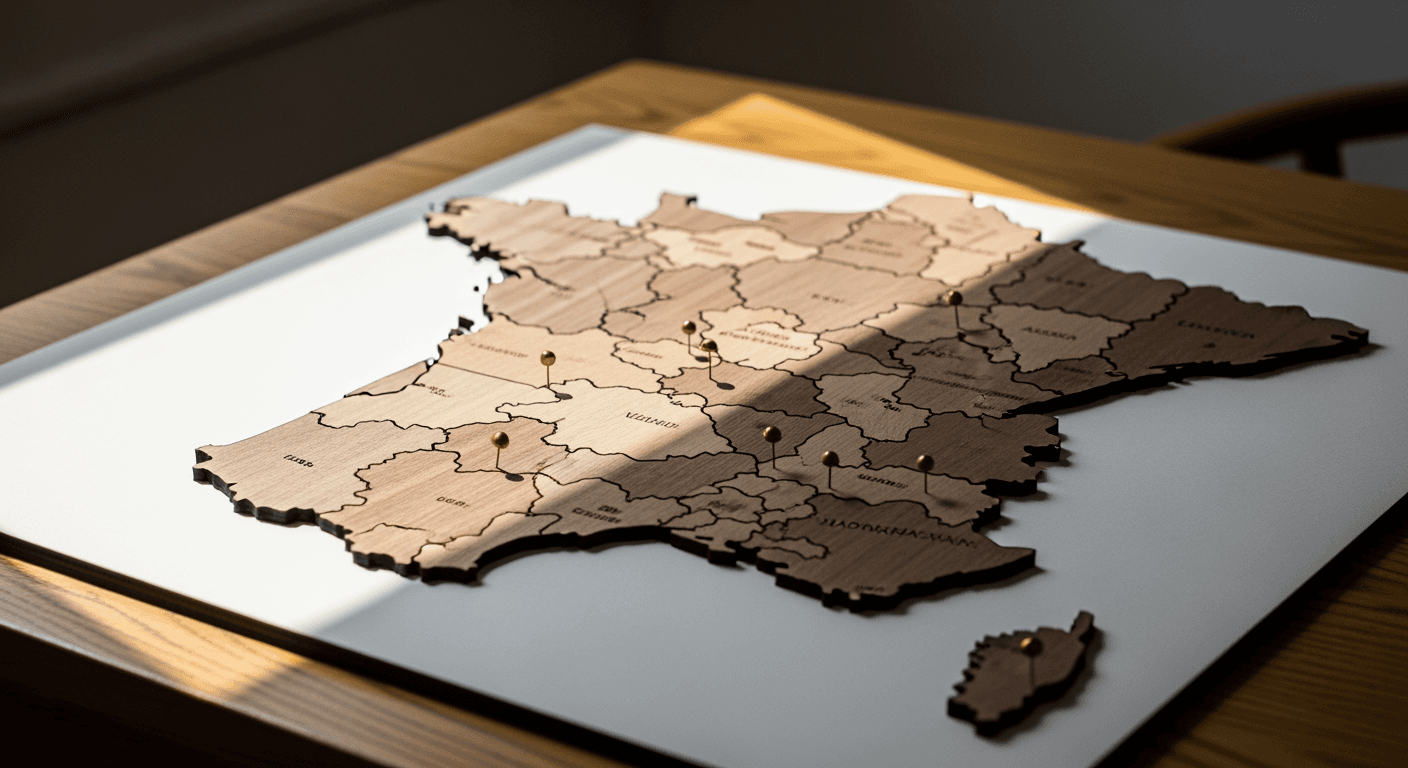
When UK buyers think of rural France, the Dordogne often comes to mind first. While beautiful, its popularity means higher prices and more tourists. For true tranquility and better value, you should look to other regions. A good place to start is an area nicknamed the 'diagonale du vide', or the 'empty diagonal'. This is a wide band of land stretching from the northeast of France to the southwest. It is known for its very low population density.

In these areas, the population is often below 30 people per square kilometer. This is much lower than the French national average of about 120 people per square kilometer. This low density creates vast areas of unspoiled countryside. It is here you will find some of the most peaceful and affordable properties in the country. Departments like Creuse, Lozère, and Cantal are part of this diagonal. They offer a more authentic and secluded French experience. Property prices here can be much lower than in the well-known hotspots.
Choosing the right region depends on your personal priorities. You should consider your budget, desired lifestyle, and how close you want to be to the UK. The following table compares some of the best regions for those seeking peace and quiet in 2026.
| Region/Department | Key Characteristics | Average House Price (per m², early 2026) | Pros for Quiet Seekers | Cons to Consider |
|---|---|---|---|---|
| Creuse (Nouvelle-Aquitaine) | Heart of the 'empty diagonal', very rural, deep countryside. | ~€1,000 - €1,200 | Extremely affordable, vast tracts of land, ultimate peace. | Fewer expats, amenities can be distant, requires self-sufficiency. |
| Burgundy (Bourgogne) | Rolling hills, vineyards, strong heritage. | ~€1,360 | Beautiful scenery, world-class food/wine, good TGV access to Paris. | Can be more expensive in famous wine areas, colder winters. |
| Normandy (Normandie) | Lush greenery, historic towns, close to UK. | ~€1,700 - €2,000 | Easy travel to/from UK, affordable stone cottages (longères). | Cooler, wetter climate; can be more populated near the coast. |
| Allier (Auvergne-Rhône-Alpes) | Forests, rivers, castles, part of the low-density diagonal. | ~€1,300 - €1,500 | Excellent value, authentic French village life, centrally located. | Less known by expats, can feel isolated in certain parts. |
When reviewing these options, think about your daily life. If you need to travel back to the UK often, Normandy's proximity is a huge advantage. If your main goal is the lowest possible price and maximum seclusion, Creuse might be your ideal choice. For those who love fine food and wine and want good connections to Paris, Burgundy offers a great balance. Allier provides a central location and authentic French life away from the main tourist trails. Researching these areas in more detail will help you narrow down your search and focus on places that truly fit your vision of a quiet life.
The 7-Step Guide to Buying Your French Retreat (2026 UK Buyer Edition)
Buying a home in France is a structured process. For UK citizens, it involves a few extra steps related to residency. This guide breaks down the journey into seven clear stages. Following these steps will help you stay organized and make informed decisions from start to finish.
Step 1: Financial & Residency Planning
Before you start looking at properties, you must sort out your finances and residency status. As a UK citizen, you can buy property in France without restriction. However, property ownership does not give you the right to live there full-time. For stays longer than 90 days in any 180-day period, you will need a long-stay visa. You must apply for this from the UK before you travel. To get a visa, you need to prove you have sufficient financial means. As of early 2026, this is around €1,440 per month for a single person. This can be from a pension, remote work income, or savings. Having a French property can support your visa application, but it is not a guarantee.
On the financial side, you need to know your total budget. This includes the property price, plus fees and taxes, which are typically 7-8% of the purchase price. If you need a mortgage, you can apply to French banks. However, as a non-EU resident, you may face stricter lending criteria. Be prepared to provide a larger deposit, often between 20% and 30% of the property value. It is wise to get a mortgage agreement in principle before you make an offer on a house.
Step 2: The Search - A "Quiet-First" Approach
Now you can start your search. When your goal is quiet, you need a specific strategy. Use French property portals and search with keywords like 'isolé' (isolated), 'sans voisins' (no neighbours), or 'au calme' (in a quiet location). This will help you filter out properties in busy villages or near main roads. However, do not rely only on the agent's description. You must become your own detective. Use online tools to investigate properties before you even think about a viewing. The French government's official mapping site, geoportail.gouv.fr, is invaluable. You can use it to see high-resolution satellite images, check property boundaries, and identify nearby roads, farms, or commercial buildings.
This digital reconnaissance helps you create a shortlist of promising properties. Look for houses set back from roads with plenty of land around them. Check for anything that could create noise, such as industrial estates, railway lines, or even popular local attractions. Beyond traditional portals, you can use conversational search tools on a platform like one-place.com to scan the market more effectively. These advanced tools can help you find homes that truly match your specific criteria for peace and seclusion.
Step 3: Due Diligence - How to Verify "Quiet"
Once you have a shortlist, it is time for viewings. This is the most important step for verifying quiet. You must visit a property multiple times. Do not just go once on a sunny afternoon. Arrange to visit at different times of the day and on different days of the week. Try to visit early in the morning, around midday, and in the evening. Also, make sure you visit on both a weekday and a weekend. This will give you a much fuller picture of the local soundscape. A quiet weekday afternoon might be very different from a Saturday morning when people are doing yard work.
During your visits, spend time outside the property just listening. What can you hear? Distant traffic? Farm machinery? Barking dogs? Talk to the estate agent and be direct with your questions. Ask about the hunting season ('la chasse'), local festivals, and any nearby farms. You should also visit the local town hall, the 'mairie'. They can tell you about any planned developments in the area, such as new roads or housing estates. Remember, it is the buyer's responsibility to check for potential nuisances. The seller is not obligated to volunteer this information.
Step 4: Making an Offer & Appointing a Notaire
When you find the right property, you will make an offer ('offre d'achat'). This is usually done through the estate agent. If the seller accepts your offer, the next step is to appoint a 'notaire'. A notaire is a government-appointed legal official who is essential for every property sale in France. They handle the legal paperwork, ensure the sale is valid, and collect all the necessary taxes. A common mistake is to think the notaire is your personal lawyer. They are not. The notaire acts as a neutral referee for both the buyer and the seller. Their job is to ensure the transaction is legal, not to protect your specific interests.
Because of this, it is highly recommended that you choose your own notaire, separate from the seller's. You have the legal right to do this. The total notaire fee is fixed by law and will simply be split between the two notaires. There is no extra cost to you. Having your own notaire means you have a legal expert who you can ask questions and who can explain the complex documents in a way you understand. This is especially valuable for foreign buyers.
Step 5: Signing the Compromis de Vente
The first legally binding contract you will sign is the 'Compromis de Vente'. This is a preliminary contract that locks in the price and the conditions of the sale. When you sign it, you will also pay a deposit, which is usually around 10% of the purchase price. This deposit is paid to the notaire, not directly to the seller. The compromis is a very important document. It should contain several contingency clauses ('clauses suspensives'). These clauses protect you if something goes wrong. For example, a common clause is one that cancels the sale without penalty if you are unable to get a mortgage.
After you and the seller have both signed the compromis, you have a 10-day cooling-off period. This period begins the day after you receive your fully signed copy of the contract by registered post. During these 10 days, you can withdraw from the sale for any reason without losing your deposit. After the cooling-off period ends, you are legally committed to the purchase.
Step 6: The Diagnostic Reports (DDT) & Survey
By law, the seller must provide a file of technical diagnostic reports. This file is called the 'Dossier de Diagnostic Technique' (DDT). It is attached to the Compromis de Vente. The DDT includes reports on various aspects of the property, such as the presence of lead and asbestos, termites, energy performance, and the condition of the electrical and gas installations. For rural properties, it will also include a report on the septic tank ('fosse septique'). These reports give you important information about the property's condition.
However, it is crucial to understand that the DDT is not a structural survey. It does not check the condition of the roof, walls, foundations, or look for issues like damp. For this, you must hire your own independent, qualified surveyor. This is an extra cost, but it is essential, especially when buying an old stone property. A structural survey can uncover hidden problems that could cost thousands to fix. The notaire will not do this for you. Getting a professional survey is the best way to protect your investment and avoid nasty surprises.
Step 7: The Acte de Vente & Getting the Keys
The final step in the process is signing the final deed of sale, the 'Acte de Vente'. This usually takes place at the notaire's office, typically two to three months after signing the compromis. Before this meeting, your notaire will send you a draft of the deed and a final statement of all the costs. You must transfer the remaining balance of the purchase price, plus all fees and taxes, to the notaire's bank account before the signing day. You will also need to show proof that you have arranged French home insurance ('assurance habitation'). This is mandatory from the day you become the owner.
At the signing meeting, the notaire will read the entire Acte de Vente aloud. If you do not speak French fluently, you may need to have a translator present. Once the document is signed by you, the seller, and the notaire, the sale is complete. You will be given the keys to your new French home. The notaire will then register the sale with the French Land Registry, and you will receive your official title deeds a few months later.

Common Pitfalls of Rural French Properties (And How to Avoid Them)
The dream of owning a rustic French cottage can quickly become a nightmare if you are not careful. Old rural properties have a unique charm, but they can also hide expensive problems. Being aware of the common pitfalls is the best way to protect yourself. Here are some of the most frequent issues buyers face and how you can avoid them.

- Structural & Renovation Issues: Many old stone houses were built without modern foundations. This can lead to movement and structural problems over time. Damp is also a frequent issue, often hidden behind new plasterboard. Renovation costs can easily spiral out of control. How to avoid: Never skip a full structural survey from a qualified, independent surveyor. They will identify these problems. Always add at least 20-30% to any renovation estimate to cover unexpected costs.
- Poor Energy Efficiency: Old properties are famous for being cold and expensive to heat. They are often poorly insulated, with single-glazed windows and old heating systems. These homes, sometimes called 'passoires thermiques' (thermal sieves), have very low energy ratings. This affects your comfort, your bills, and the future value of the property. How to avoid: Pay close attention to the energy performance report (DPE) in the DDT. Budget for upgrades like double glazing, insulation, and a modern heating system. These improvements can be costly but will save you money in the long run.
- Septic Tanks (Fosse Septique): Most rural homes are not connected to mains drainage. They use a septic tank instead. French regulations for septic tanks are very strict. If the system does not conform to modern standards, the new owner must upgrade it. A full replacement can cost between €10,000 and €15,000. How to avoid: The septic tank report in the DDT will state if the system is compliant or not. If it is not, you must get quotes for the replacement work before you sign the Compromis de Vente. This cost will be your responsibility after the purchase.
- Boundary & Access Rights: Fences are not as common in rural France as in the UK. This can lead to confusion over property boundaries. There may also be hidden rights of way ('servitudes') across your land. For example, a neighbour might have the right to walk across your garden to access their field or a well. How to avoid: Ask the notaire to check the official land registry map ('plan cadastral') and to confirm all boundaries. They must also check for any registered servitudes. It is vital to know exactly what you are buying and who has the right to access it.
- Farming Rights: Be careful if you are buying a property with a lot of land. A local farmer may have been using part of the land for years based on a verbal agreement with the previous owner. This 'friendly agreement' can sometimes establish legal farming rights ('droit d'usage') that you cannot easily terminate. How to avoid: Ask the seller and the notaire directly if any part of the land is currently being used by a third party. Ensure the Acte de Vente clearly states that the property is sold free of any rental or usage agreements.
Making Your Decision and Finding Your Perfect Quiet Corner
Finding a quiet rural property in France is an exciting journey. As a UK buyer in 2026, the dream is absolutely achievable. The key to success is thorough preparation and a clear understanding of what 'quiet' really means in the French countryside. It is not about finding silence, but about finding a place where the sounds of rural life are a welcome part of the experience.

Remember the most important lessons. First, define your personal definition of quiet and research regions that match your budget and lifestyle. Second, embrace the role of a detective during your search. Use online tools and conduct multiple visits to create a 'noise profile' of any property you consider. Finally, follow the legal process carefully, appoint your own notaire, and never skip a structural survey. This diligence is your best protection against future problems.
The traditional property search, scrolling through hundreds of listings, can be frustrating. Finding a truly quiet home requires more than a simple filter. To make your search easier, you can use smarter tools. A conversational search can scan the entire French market to find properties that truly match your vision for a peaceful life. With the right approach, you can turn your dream of a tranquil French retreat into a wonderful reality.