


Knowing what to ask during a virtual property viewing abroad starts with knowing what the camera can show. A virtual viewing is a live walk-through of a real home. You can ask the agent or seller to stop, turn the camera or go back to a room before moving on.
Whether you're considering a home in France, Estonia, Italy, Spain or Portugal, use the call to decide if the property deserves a closer look. Compare what you see with the listing, request simple demonstrations and set aside questions that need written evidence or someone local to investigate.
Article summary
- Prioritize requirements and budget questions: pursue with checks if layout and setting suit, pause for unresolved costs or condition, or pass on a firm mismatch.
- Before calling, test listing claims against your needs with One Place’s page, which groups duplicate listings to compare photos and specifications.
- Ask for periods and inclusions of recurring charges, then request statements to set your budget.
- Before proceeding, ask a local property professional what visible damage they can assess and what access is needed.
Before the call, compare the listing with your needs
Start with the features that could change your decision. What to ask during a virtual property viewing abroad depends on how you plan to use the home and which claims the listing makes.
Match important listing claims to camera requests
One Place brings duplicate listings together on one property page, so you can compare room photos and specifications before deciding what to ask about.
Suppose a listing describes a second bedroom and you need a room for calls while someone else is home. Ask the agent to start in the hallway, walk into the room and show the door closed. Request a view of the space where you'd put a desk. The room's label leaves those practical questions open.
Send the most important requests ahead of time. That gives the person on site a chance to arrange access and tell you which views are possible. If a listing photo leaves you unsure which room it shows, send the picture and ask the agent to start at that exact spot.
If you're unsure who the agent represents, settle that before discussing the purchase. A short list of agent vetting questions can help you establish who is answering for the seller and who will handle your requests after the call.
Use the same notes for every home
Give each address its own sheet. The U.S. Department of Housing and Urban Development's Homebuying Checklist recommends a separate checklist for each home so you can compare entries later. Keeping the same fields across viewings helps you compare homes even when agents take different routes through them.
Give each point that matters to you a line with these fields:
- The requirement the home needs to meet.
- The wording or photo in the listing that prompted the check.
- The angle or route you want the camera to show.
- The question you need the agent or seller to answer.
- The written evidence or local check you may need afterward.
Write down any deal-breaker before you see the home. If you need step-free access, for example, put that in the requirement field and ask to see the route from the street. A broad note such as "good access" will be harder to interpret when you compare homes later.
Keep the sheet open alongside the call. Leave space next to each request so you can record a brief answer without interrupting the walk-through. If the presenter starts somewhere unexpected, you can follow along and return to anything they missed before the call ends.
During the tour, ask the person on site to show the whole home
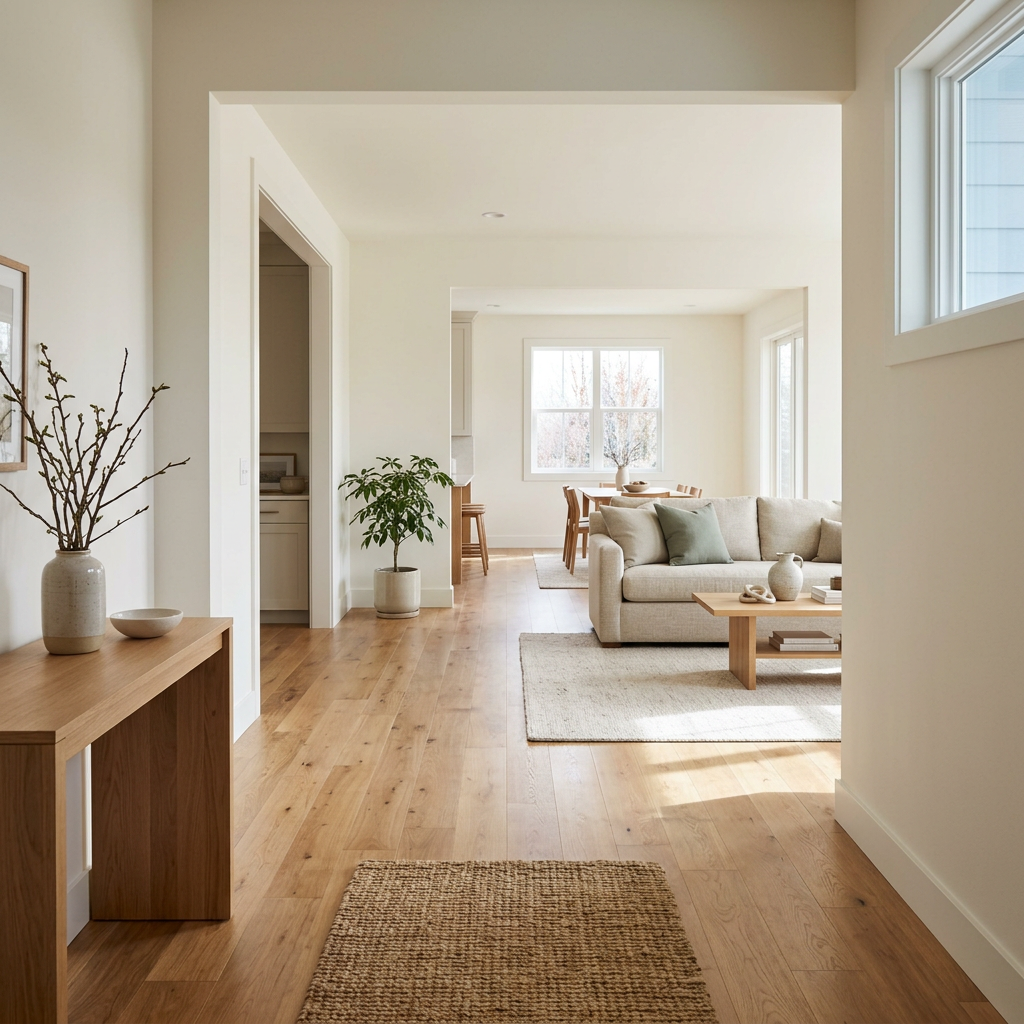
Ask for a continuous walk from the entrance so you can see how the rooms connect. Once you understand the route, ask the person on site to go back for details that matter.
Start with the room layout, then request close-ups
A wide shot helps you place the doors and windows before you ask about a particular wall or corner. If you have a floor plan, follow it during the call. When the route seems different, ask the presenter to stand at the previous doorway and show where both rooms lead.
Keep these camera requests handy and use them where they answer a question about the home:
- "Can you walk from the entrance and pause for a wide shot in each room?"
- "Can you hold the camera still near that mark and show the surface around it?"
- "Can you open that cupboard so I can see its depth and condition?"
- "Can you show how this window opens if you have permission and it's safe?"
- "Can you switch on this light or fan so I can see what happens?"
- "Which areas haven't we seen, and what kept you from showing them?"
If you spot a mark along a window surround, ask for a close-up and then a wider view. The close-up shows the mark; the wider view tells you where it is. Ask whether anyone has looked into it and record the location so you can refer to it later.
Ask to see features in use
The UK professional scope for a Home Survey Level Three gives useful prompts for watching household systems in ordinary use. It includes observing a sample of lights and extractor fans, which draw air out of a room, and asking the occupier to operate the heating.
In the bathroom, ask for a steady view while the person on site switches on the extractor. Record what you could see or hear. If the sound on the call is unclear, note that separately from the agent's account of what happened. Seeing or hearing a fan run establishes only that it operated during the call.
For heating, ask who can operate it and where the controls are. If the occupier can turn it on, have them show you what changes at the controls. A question about safety or condition needs a separate assessment. Leave windows closed if the presenter lacks permission, the key is unavailable or opening them would be unsafe.
Record what the camera could not reach
At the end of the walk-through, ask which spaces the presenter accessed and which remain unseen. Use your notes to name the space. "Can we see the storage room off the landing?" is easier to answer than "Did we miss anything?"
Record why you couldn't see each space. A door with an unavailable key calls for a different follow-up than a corner the camera passed too quickly. Ask who can arrange access to the locked room. For the missed corner, ask the presenter to return while they're still on site.
Sometimes you see a feature but can't place it. A close-up of a storage space, for instance, leaves open how you reach it and which door to use. Ask for a continuous view from the nearest point you recognize. If that route can't be shown, record access as pending even if you've seen the space itself. That distinction matters when the storage affects whether the home meets your needs.
Check light, noise, access and the shared surroundings
Ask to see the home from its windows and from the route you'd use to get in. Those views help you judge how the property would work on an ordinary day.
Look beyond the room
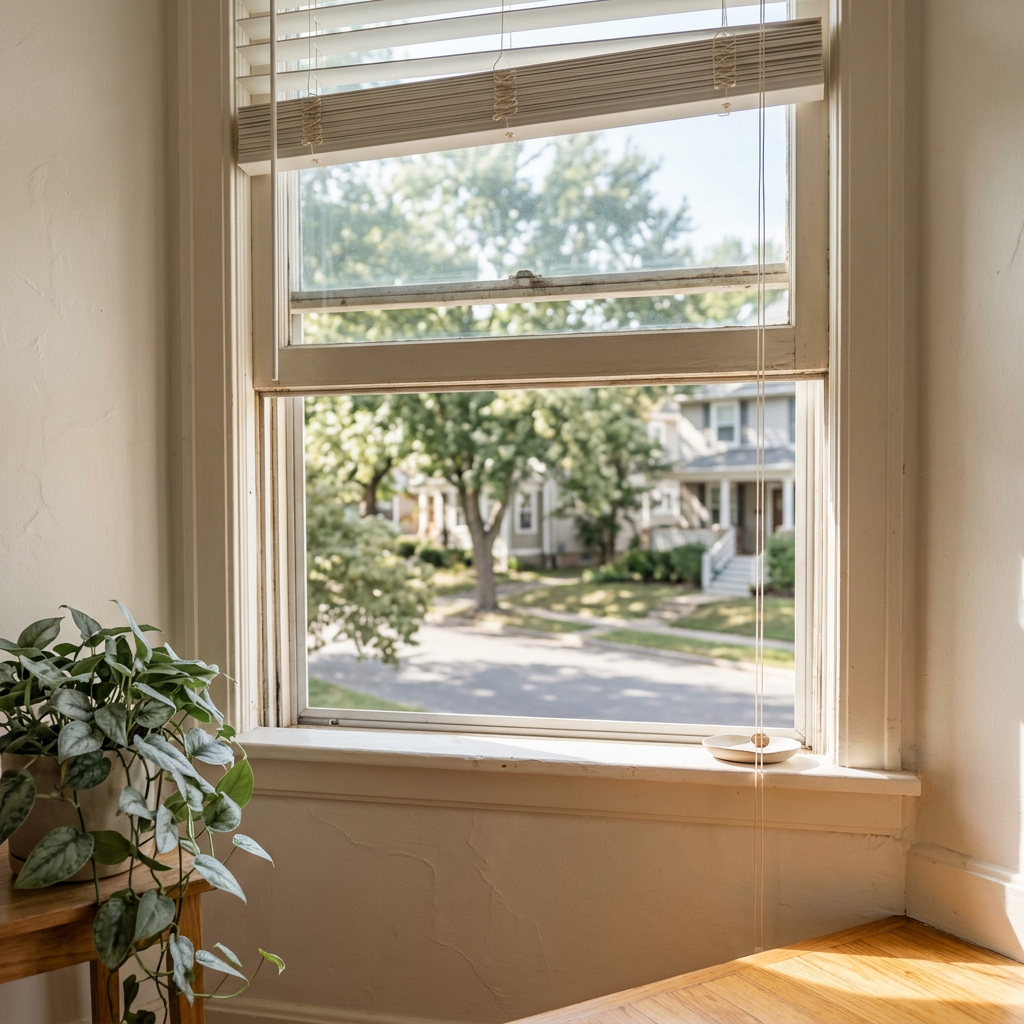
Ask the presenter to stand where you'd normally sit or work and turn toward the window. Then ask for a closer look outside. A view directly against the glass tells you what's outside; the view across the room tells you how much of it you'd see in daily use.
You may want a bright room or more privacy. Ask whether the room lights are on and whether the blinds can be opened. Have the presenter show the space in daylight if the timing allows. If the call falls after dark, ask for daylight images taken from the same position.
Look for nearby windows or buildings in the same shot. If a balcony matters to you, ask the presenter to show the doorway, step out if they can and pan along the usable area. Ask which part, if any, is shared. Knowing where the boundary is will help you decide which details to request in writing.
Listen during a quiet stretch of the call
Ask the presenter to stop talking briefly in a room where quiet matters to you. If possible, listen again near the entrance outside. When you hear something you can't place, ask where it comes from and whether the person on site hears it at other times.
A call captures the conditions at that moment. If traffic noise matters because you'll be working at home, ask what the street is like during your working hours. If the answer is vague, request a second listen during the period you care about or ask someone local to visit then.
Ask about odors directly because you depend on the person on site to describe them. A useful question is, "Do you notice any persistent smell in this room?" If the presenter reports one, ask where it's strongest. Keep that observation in their words. The cause is a separate question, and you can decide whether it warrants a local visit before you go further.
Follow the route you'd use every day
For an apartment, ask to see the common entrance and the route to the unit. Have the presenter show you any lift, stairs or thresholds that affect how you'd get in. For a house, start at the point where you'd arrive and ask them to show the approach to the door.
Use these questions to connect what you see with how you'd use the property:
- "Where would I park, and where is my use of that space written down?"
- "Which shared facilities could I use, and are there written restrictions?"
- "Which stop or nearby service would you use, and where is it on the map?"
Ask for the name or location of the stop or service that matters most to you. Trace the route on a map after the call. A precise destination helps you judge whether the route suits you when the person on site describes it simply as close by.
Ask about costs, repairs and details to check later
Use the end of the call to ask what the home costs to run, what work has been done and what comes with the sale. Ask for records while you both know which charge, repair or item you're discussing.
Request written details for costs and recent work
Start with charges that could change what you can afford. When the agent gives an amount, ask which period it covers and what's included. Ask for the statement that shows the charge, so your budget can use the same period and items as the written record.
When a repair comes up, ask what was done and when. A description such as "recently redone" gives you little to work with if you need to ask about a specific part later. Ask whether dated records identify the work and the area it covered.
Put the requests that could affect your decision into your notes before you hang up:
- The statement showing recurring charges and the period they cover.
- Dated records describing repairs or renovations mentioned on the call.
- A written list of included items and any available records of their age or servicing.
- A named contact and expected response date for evidence the presenter can't supply.
Separate what was shown from what was said
Use short labels in your notes: "Seen," "Stated," "Documented" and "Pending." The labels belong to individual claims. A single room can give you information in several categories, so avoid marking the whole room as checked.
Suppose the camera shows a dishwasher and the agent says it comes with the sale. Its presence is "Seen" and its inclusion is "Stated." If inclusion matters to you, keep the written list "Pending." When it arrives, mark inclusion "Documented" if the list actually names the appliance. Its working condition is a separate point.
Ask the agent to spell unfamiliar local terms and include them in the follow-up. That gives you the wording to look for in a document. If a translated answer seems broad, put the specific question back to the agent. For a charge, for example, ask what it pays for and who collects it. Record the answer alongside the original wording so you can return to it later.
Get local help for inaccessible or specialist issues
The Royal Institution of Chartered Surveyors describes a UK home survey as an in-depth visual inspection with a written report. Its consumer guidance calls for further investigation where access is limited or specialist knowledge is needed.
Use that distinction to decide who should answer each question. If an agent missed a reachable area, another live look may be enough. If you need to understand the cause of visible damage, ask a relevant local property professional what they can assess and what access they would need.
Give that person a location and a question. For example, identify the ceiling above the upstairs landing and ask what needs examining before you decide whether to proceed. Request a written account of what they could see and what needs a further visit. If access depends on the seller, ask the agent who can arrange it and when. That gives you a way to plan the next check without asking the presenter to diagnose the problem.
After the call, decide what still needs checking
Decide whether to spend more time on the property by looking at the questions that could change your answer. A clear view of a minor detail carries less weight than an unresolved question about one of your requirements.
Decide whether to pursue, pause or pass
Knowing what to ask during a virtual property viewing abroad is useful only if the answers help you make a decision. Give priority to the facts that could change your plans or budget. A short list of unresolved points can matter more than a long list of views the agent managed to show.
Choose the next step that fits what you know about the home:
- Pursue. If the layout and setting suit you, move on to the written and local checks that could affect whether you'd buy.
- Pause. If a major cost or condition question remains open, wait for the specific evidence that would let you decide.
- Pass. If the call establishes that the home misses a firm requirement, put your time into another property.
If an answer depends on someone who wasn't present, leave that item open until the right person responds. You can keep the home on your shortlist and continue viewing others while you wait. That keeps your search moving without treating a promised reply as evidence.
Turn a first screen into a written follow-up
A virtual open house can help you judge the layout and visible features. If the format gives you little time to ask questions, request a separate call for anything that could decide the purchase. Use the same follow-up process you would after a private tour.
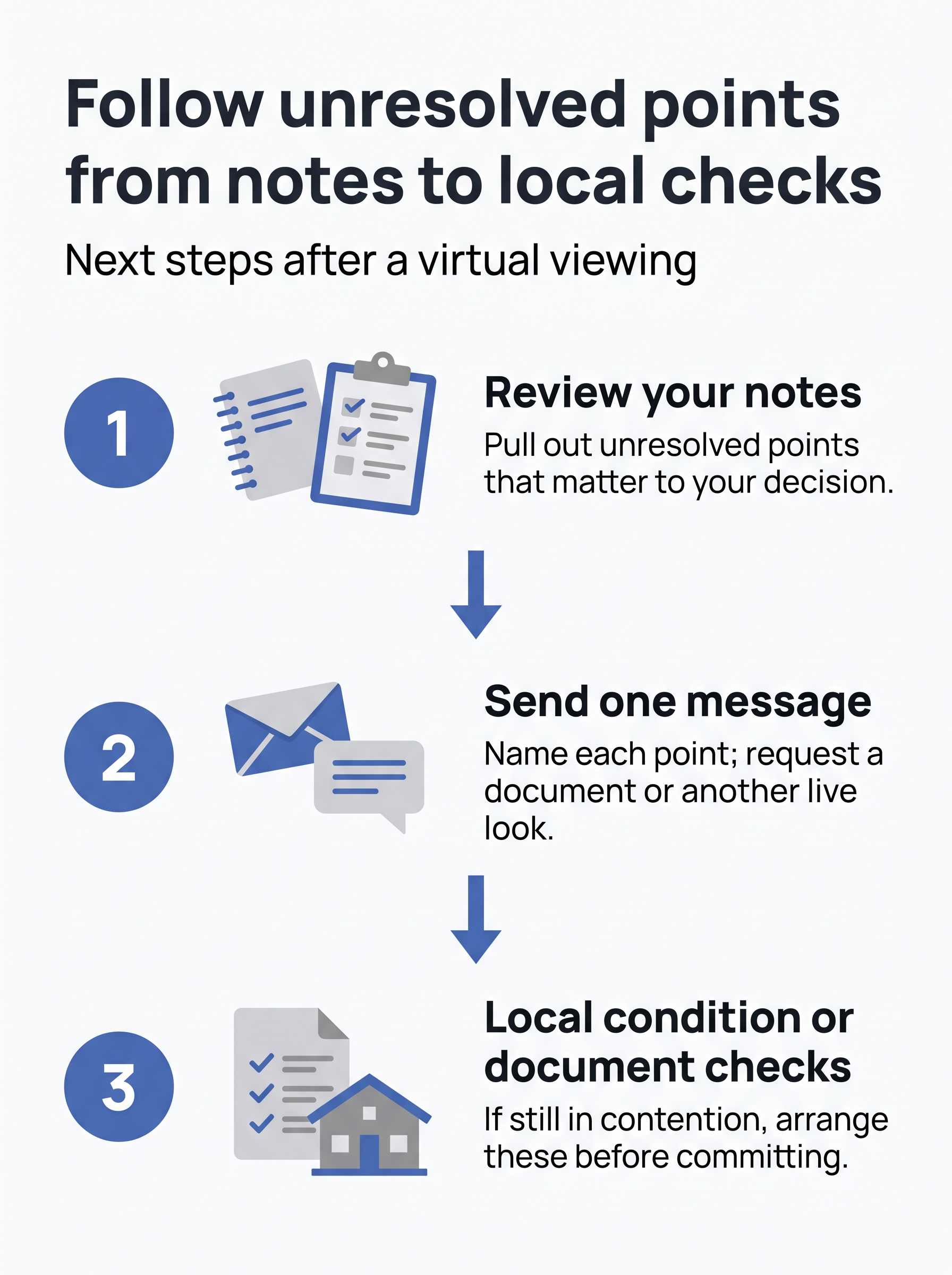
Complete these steps in order so the next request follows from what you actually learned:
- Review the labels in your notes and pull out the unresolved points that matter to your decision.
- Send one message naming those points and asking for the specific document or another live look at each one.
- If the answers still leave the property in contention, arrange local condition or document checks before making a commitment.
Start the message with the address or listing reference so the recipient can identify the home. Put the deciding question first and say what would answer it. If the reply covers only part of your request, keep the remaining point open. A partial reply can still be useful if it tells you who has the record or when the space can be shown.
Frequently asked questions
What are some good questions to ask during a virtual apartment tour?
During a virtual apartment tour, ask the person on site to show the apartment and shared access areas, then ask how parking and any restrictions affecting the home are documented. HUD’s U.S. checklist includes parking and neighborhood restrictions as comparison fields, so treat these as prompts rather than rules for other countries.
What are some good questions to ask when viewing a property?
When viewing a property, ask which areas were not accessible, what visible defects need follow-up, and who can assess them. RICS says further investigation may be needed when areas are hidden or inaccessible, or specialist knowledge is required, so record those points rather than treating the video as a full assessment.
What are some good questions to ask during a house tour?
During a house tour, ask the person on site to operate a sample of lights and extractor fans and show the heating in normal operation where practical. Treat this as observation, not a safety test: RICS’s Level Three scope says services are not tested.
What is virtual viewing?
A virtual viewing is a live video walk-through of a real residential home, not a virtual-reality experience or static online listing. The buyer can direct the person on site to show particular rooms or features and record what still needs checking afterward.
Can you give me an example of a virtual tour?
One example of a virtual property tour is a live call in which the buyer asks the agent to pause in the bathroom, show a close-up, and operate the extractor fan. RICS’s Level Three scope includes observing a sample of extractor fans in normal operation; that observation is not a safety test.
Are virtual open houses worth it?
Yes, virtual open houses can help screen a home’s layout and visible features, but they are not a complete condition assessment. RICS describes a Home Survey as a separate in-depth visual inspection that produces a written report; this is a UK professional service, not a rule for every country.


